

Introduction
The words “magical” and “digital” go together more than you would think. How? you may be asking. In this blog post we will go over why it’s magical, especially when compared to analog.
Digital vs Analog
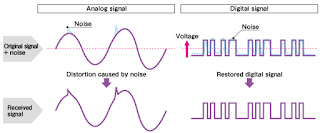
In a previous blog post, I have talked about the differences between digital and analog, and now I am going to showcase another one, specifically going into talking about transmitting. There is a handy chart here to show you what I mean.
Since analog has a continuous signal, always ebbing and flowing. Sometimes noise can rattle through and blur the original signal. Analog, being continuous, has no way to distinguish between the noise and the original signal.
Now, there’s a common belief that digital doesn’t pick up noise, and that is why it’s considered magic. That is false. Digital, does, in fact, pick up noise. But it is able to separate the noise from the signal, because the signal is made up of numbers. To a digital receiver, a noisy 1 is still a 1.
Conclusion
A good way to remember this is that mistakes get amplified with analog signals, but are gone with digital signals. It’s not because digital doesn’t get noise with its’ signals, but are able to block it out, which seems more magical to me.